The Power of Compound Interest: Growing Wealth Over Time
Compound interest transforms patience into profit. When you save or invest consistently—even modest amounts—your money grows exponentially over time. The secret? Starting early gives your contributions more time to multiply. Let’s examine how this works in practice.
What Is Compound Interest?
Compound interest is interest you earn on your original money plus on the interest it has already earned. Simple interest only pays you on the amount you put in. Compound interest pays you on a balance that keeps getting bigger, so your growth speeds up the longer you leave it alone.
Here is a quick illustration. Put $1,000 in an account earning 5% a year. After year one you have $1,050. In year two you earn 5% on $1,050, not $1,000, so you end with $1,102.50. That extra $2.50 looks tiny, but the same effect repeated for 30 or 40 years is what turns small, steady savings into real wealth.
The standard formula is A = P(1 + r/n)nt, where P is your starting amount, r is the annual interest rate, n is how many times a year interest compounds, and t is the number of years. You don’t need to do this by hand. The SEC’s free compound interest calculator on Investor.gov will run the numbers for any scenario you want to test.
Compound Interest Example 1: The $100 Monthly Habit
Imagine you’re 25 and commit to saving $100 monthly in an account earning 5% annual interest, compounded monthly. Fast-forward to age 65—what’s waiting for you?
- Monthly contribution: $100
- Your total deposits over 40 years: $48,000
- Interest rate: 5% annually, compounded monthly
- Final balance: approximately $152,600
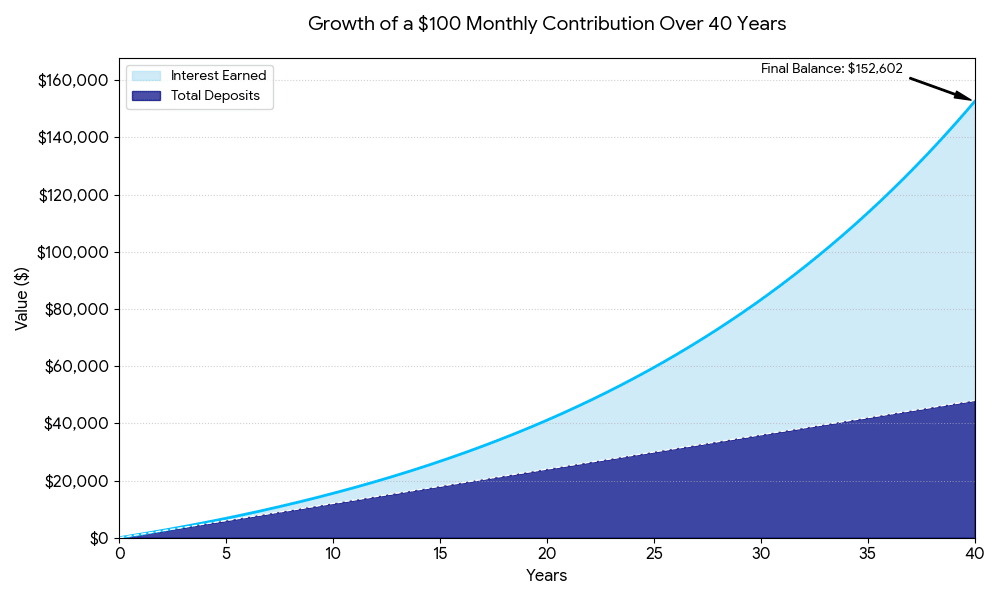
You’ve more than tripled your money. If the same deposits earned simple interest instead, you’d end up with roughly $96,000. That extra $56,600 or so is compound interest working behind the scenes—your earnings generating their own earnings for four decades. Notice that most of the growth shows up in the final 15 years. That is the compounding curve at work, and it is why patience pays.
Why Starting Early Matters: The Cost of Waiting
Meet Alex and Bella. Both invest a one-time $5,000 in a stock fund averaging 7% annual returns.
- Alex invests at 25. At 65, that $5,000 becomes roughly $74,900.
- Bella invests at 35. At 65, her identical investment grows to about $38,100.
Same amount invested. Ten-year difference. Bella ends up with less than half of Alex’s total. Time doesn’t just help—it multiplies your results.
Waiting is expensive because the years you skip are not the cheap early years—they are the final years, when your balance is largest and each year of growth adds the most dollars. Bella would need to invest about $9,800 at age 35 just to catch up with Alex’s $5,000.
How Often Interest Compounds (and Why It Matters)
Interest can compound annually, monthly, or even daily. The more often it compounds, the slightly faster your money grows, because interest starts earning interest sooner. Here is $10,000 left alone for 10 years at 5%:
- Compounded annually: about $16,289
- Compounded monthly: about $16,470
- Compounded daily: about $16,487
The difference is real but small. Your rate and your time in the market matter far more than the compounding schedule. When comparing savings accounts, look at the APY (annual percentage yield), which already includes the effect of compounding, so you can compare accounts fairly.
The Rule of 72: A Quick Compound Interest Shortcut
Want a fast way to estimate growth without a calculator? Divide 72 by your annual return. The answer is roughly how many years it takes your money to double.
- At 8% a year, money doubles in about 9 years (72 ÷ 8)
- At 6% a year, it doubles in about 12 years (72 ÷ 6)
- At 4% a year, it doubles in about 18 years (72 ÷ 4)
- At 0.5%—a typical big-bank savings rate—it takes about 144 years
That last line is why where you keep your money matters. The same dollars can double nine times faster just by sitting in a better account or investment.
How to Put Compound Interest to Work
Ready to tap into this financial advantage? Here’s your action plan:
- Start Now: Time is irreplaceable. Whatever you can save today—$20, $50, $100—begins growing immediately.
- Choose Smart Vehicles: Consider high-yield savings accounts, certificates of deposit (CDs), or low-cost index funds and ETFs (historically 6–8% annual returns, though not guaranteed). Match your choice to your timeline and comfort with risk.
- Use Tax-Advantaged Accounts: An IRA or 401(k) lets your money compound without being reduced by taxes every year, which can add tens of thousands of dollars over a career.
- Automate Contributions: Set up recurring transfers to remove friction and build wealth on autopilot.
- Reinvest Everything: Keep interest and returns working for you rather than cashing out. This accelerates the compounding effect.
When Compound Interest Works Against You
Compounding is just math, and it works the same way on debt. Credit card balances often carry APRs above 20%, and that interest compounds too. A $5,000 balance at 22% APR that you leave untouched for one year grows to roughly $6,200. Leave it for five years and it grows to nearly $15,000.
That is why paying off high-interest debt is one of the best “returns” you can earn. Every dollar of 22% debt you eliminate is like earning a guaranteed 22%. Keeping balances low also protects your credit score, which lowers the rates you pay on future loans.
Important Considerations
- Risk vs. Reward: Higher potential returns typically mean higher volatility. Stocks can soar or stumble; savings accounts offer stability but smaller gains. Choose what aligns with your goals and sleep-at-night factor.
- Watch the Fees: A seemingly small 1% fee can significantly erode returns over decades. Seek out low-cost options—index funds with expense ratios under 0.5% are ideal.
- Think Long-Term: Compound interest requires time to work its magic. Resist the urge to dip into your savings prematurely. Consistency beats timing.
Compound Interest FAQ
Is compound interest better than simple interest?
When you are saving or investing, yes. Compound interest grows your balance faster because you earn returns on past returns. When you are borrowing, simple interest is cheaper for you.
Do savings accounts use compound interest?
Most do. Many banks compound daily and pay interest monthly. Check the APY to see the true yearly rate after compounding.
How much do I need to start?
Nothing more than what you have. Even $20 a month benefits from compound interest. Before investing, it helps to have an emergency fund in place so you never have to pull money out early and interrupt the growth.
Your Next Move
Compound interest isn’t complicated—it’s simply math working in your favor when you give it time. Whether you’re setting aside $50 monthly or investing a $1,000 windfall, what matters most is beginning today.
Open that high-yield savings account. Research a low-cost index fund. If you are brand new, start with our guide on what investing is and how to start confidently. Talk with a financial advisor if you need guidance. Your 65-year-old self will look back grateful that you planted these seeds now, watching them grow into genuine financial security.
The best time to start? Years ago. The second-best time? Right now.
Disclaimer: I am not a financial professional or advisor; I am merely an individual who has gained knowledge through personal experience and extensive reading. The advice provided herein is based on my personal journey and general common sense. It is crucial to recognize that each individual’s circumstances are unique, and therefore, I strongly recommend consulting a qualified financial advisor or conducting thorough research before making significant financial decisions. For educational purposes only.



4 Comments